
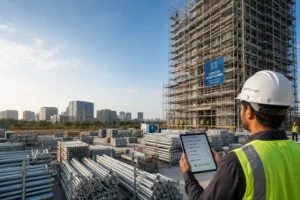
In the high-pressure world of Bangalore’s construction sector, scaffolding is often treated as a simple commodity just some pipes and boards to be rented at the lowest rate. However, veteran managers know that the true cost of access isn’t the rental price; it’s the efficiency of the operation.
Effective scaffolding project management Bangalore is the difference between a site that runs like clockwork and one that loses lakhs in labor delays and logistics bottlenecks. This guide explores how to master site logistics, cut labor downtime, and ensure every rupee spent on your rental maximizes your project’s ROI.
The Logistics of Height: Streamlining Material Movement
When managing a high-rise project in a congested hub like Bengaluru, the biggest challenge isn’t just getting the equipment to the gate; it’s getting it to the 20th floor without clogging up the entire site. Scaffolding site logistics is essentially a vertical transport problem. If your material handling isn’t synchronized with your crane or hoist schedule, you end up with expensive equipment sitting idle on the ground while your labor force waits at height. This delay ripples through the entire project timeline.
Strategic scaffolding rental in Bangalore requires planning for mobilization and demobilization long before the trucks arrive. In narrow urban zones like Indiranagar or MG Road, truck entry timings are strictly regulated. A project manager must coordinate these windows to ensure that lead times are accounted for and that unloading doesn’t happen during peak traffic hours, which can result in heavy fines or turned-away deliveries.
Just-in-Time (JIT) Delivery: Reducing On-Site Clutter
On a crowded job site, floor space is premium real estate. Traditional construction site logistics often involve dumping all components at once, which leads to “material burial” where the pieces you need first end up at the bottom of the pile. Just-in-Time (JIT) delivery solves this by staggering equipment arrival according to the erection sequence.
By utilizing small, staged deliveries, you maintain a clear staging area and reduce the risk of inventory loss. For example, delivering only the standards and ledgers for the first few lifts ensures your crew can start immediately without tripping over specialized brackets or walk-boards that won’t be needed for another two weeks. This keeps inventory tracking simple and prevents site clutter from becoming a safety hazard.
Key Insight: Vertical logistics is the heartbeat of height access. By synchronizing equipment delivery with your hoisting capacity and using JIT principles, you eliminate the “wait time” that often kills productivity on Bangalore high-rises.
Optimizing Labor: Cutting Down Assembly and Dismantling Times
In any major construction budget, labor is usually the most volatile variable. While the rental price of the steel is fixed, the cost of the people putting it together can skyrocket if the process is inefficient. Construction labor optimization in scaffolding is all about reducing the total man-hours required to reach a specific height. If your crew is spending hours searching for the right pins or struggling with heavy, non-standardized components, your project schedule is already at risk.
Efficient project management focuses on the “Ease of Assembly.” By selecting systems that prioritize speed, you can significantly reduce the size of the crew needed on-site. In the Bengaluru market, where skilled labor can be hard to source during peak seasons, reducing the technical complexity of the build is a strategic move. A faster double pole assembly in Bangalore means your masonry or painting teams can get to work sooner, keeping the entire project lifecycle on track.
System Scaffolding vs. Traditional: The Labor ROI Impact
When calculating your scaffolding rental ROI, the choice between traditional pipes and fittings versus modern system scaffolding is the biggest factor. Traditional “tube and clamp” systems offer flexibility but are labor-intensive, requiring highly skilled riggers to ensure every joint is secure. On the other hand, system scaffolding like Cuplock uses pre-engineered locking points that eliminate most of the guesswork.
The data is clear: system scaffolding can be erected up to 30% to 50% faster than traditional methods. For a project manager, this translates to massive savings in daily wages. While the daily rental rate for Cuplock might be slightly higher, the reduction in man-hours usually results in a much lower total cost. Highlighting the cuplock scaffolding advantages in Bangalore often shows that the speed of the “node” connection allows a smaller team to cover more square footage per day than they ever could with manual clamps.
Calculating the Real ROI of Your Scaffolding Rental
Many procurement teams in Bangalore fall into the trap of choosing a vendor based solely on the lowest monthly quote. However, the true scaffolding rental ROI is a measure of how that equipment facilitates or hinders your project’s progress.
To get an accurate picture, you must look at the “Cycle Time”: the speed at which a scaffold can be erected, used, moved, and dismantled. A cheap system that is slow to move actually costs more in crane time and site overheads than a premium system that stays ahead of your masonry schedule.
Using a proper scaffolding rental calculation in Bangalore helps you see the bigger picture. High asset utilization is the goal. If a scaffold stays on-site for six months but is only active for three, your ROI is effectively halved. A well-managed project ensures that the moment a section of work is finished, the equipment is demobilized or moved to the next block to stop the rental meter.
The Scaffolding ROI Formula:
$$\text{ROI Factor} = \frac{\text{Value of Project Time Saved} + \text{Labor Costs Reduced}}{\text{Total Rental Cost} + \text{Logistics Fees}}$$
Hidden Costs: Managing Loss Prevention and Damage Charges
One of the most common drains on a construction budget occurs during the final “off-hire” count. Inventory tracking is critical because small components like pins, clamps, and base jacks are easily lost or buried in debris. Without a systematic way to log material as it arrives and leaves, you might find yourself facing significant “loss and damage” charges.
Modern inventory tracking involves clear material logging during every mobilization and demobilization stage. By designating a specific, fenced storage zone and training the crew to return components daily, you reduce the risk of items being misplaced. Effective loss prevention isn’t just about security; it’s about keeping your final bill predictable and avoiding scaffolding rental mistakes in Bangalore.
2026 Management Trends: Digital Tracking & Compliance
As we move through 2026, scaffolding project management Bangalore has shifted from manual ledgers to digital-first strategies. The complexity of modern high-rises means that project managers can no longer afford to guess their inventory levels. Real-time digital tracking using QR codes or cloud-based logging has become the standard for top-tier sites. This allows for instant site audits, drastically reducing the “missing material” disputes that plague the end of a project.
Beyond inventory, digital tools are central to meeting the Work at Height Regulations Bangalore 2026. These updated norms require precise documentation of every structural change and inspection. By moving these records to a digital platform, project managers can prove compliance in seconds during a surprise labor department visit.
Safety as a Productivity Tool: The 2026 Audit Loop
In the past, safety inspections were seen as a hurdle. Today, efficient sites use the “Audit Loop” to drive productivity. By strictly following a daily scaffolding inspection checklist, managers catch minor issues like a loose coupler before they turn into site-wide shutdowns.
Implementing a visible tagging system (Green for “Safe,” Red for “Danger”) creates a clear communication channel. When a worker sees a Green tag, they move onto the platform with confidence, working faster. This eliminates the “uncertainty downtime” where crews wait for verbal confirmation. In 2026, a safe site is statistically a faster site.
FAQs: Managing Complex Scaffolding Projects in Bangalore
How do we handle “No Entry” truck timings for deliveries?
Bangalore traffic police strictly enforce windows where heavy vehicles cannot enter the city typically 7:00 AM – 11:00 AM and 4:00 PM – 10:00 PM. To avoid fines, we recommend scheduling mobilization for a 5:00 AM “pre-dawn” delivery. This ensures material is on-site and ready for the 8:00 AM shift.
What is the best strategy for sites with narrow access?
In congested zones like Chikpete or SP Road, the best approach is a “Trans-shipment” model: unloading at a nearby accessible point and using smaller pick-up vehicles for the last-mile delivery. Knowing how to choose the right scaffolding for these tight spaces such as modular systems that are easier to hand-carry is vital.
How can I benchmark my labor productivity?
The industry standard is to track “man-hours per tonne.” If your crew is taking significantly longer than the benchmark, it is usually a sign that site logistics have failed, and the crew is spending too much time walking to fetch parts rather than assembling them.
Action Steps: From Blueprint to Demobilization
Transitioning from a complex drawing to a functional structure requires a methodical approach. A successful project starts with a detailed site audit to identify ground stability issues and overhead obstacles long before the first truck leaves the warehouse.
Once the audit is complete, draft a formal logistics plan. This acts as your roadmap, mapping out material arrival, staging areas, and vertical lifting coordination. Partner vetting is equally critical. Your rental provider shouldn’t just be a vendor; they should be a logistical partner who understands the rhythm of your project.
Choosing a dedicated partner like Sri Kanakadri Scaffolding ensures that your access needs are managed by experts. From the initial blueprint review to the final demobilization, having a team that prioritizes your ROI lets you focus on the building while we handle the height.
Key Insight: A project is won or lost in the planning phase. A robust site audit combined with a collaborative logistics plan is the only way to guarantee that your scaffolding remains an asset rather than a bottleneck.
Contact Sri Kanakadri Scaffolding Today!
Phone: +91 9113276916
Visit our Google My Business Listing for Directions

About Sri Kanakadri Scaffolding Author – Sri Kanakadri provide Bangalore’s most reliable scaffolding on rental services, offering safe, cost-effective, and top-quality scaffolding rental solutions for all construction projects. With years of expertise, Sri Kanakadri Scaffolding is committed to delivering exceptional scaffolding on rental services in Bangalore that exceed client expectations. Our focus is on safety, quality, and affordability for every construction project. e specialize in scaffolding hire in Bangalore, offering reliable and cost-effective scaffolding rental solutions tailored to your needs. From construction scaffolding services to industrial scaffolding on rent, we ensure precision, safety, and efficiency in every project. Trust us for affordable scaffolding rentals that guarantee unmatched professionalism and reliability.