In Bangalore’s race to the sky, the cost of negligence is higher than ever. With the Karnataka government tightening enforcement of the BOCW Act in 2026, understanding work at height regulations in Bangalore is no longer just about safety—it’s about legal survival. Whether you are developing tech parks in Whitefield or high-rise residential towers in Hebbal, strict compliance is the only way to protect both your workforce and your business. This guide breaks down the mandatory norms, from BBMP bylaws to advanced fall arrest systems, ensuring your project stays compliant and your sites remain accident-free.
The Regulatory Landscape: BOCW Act & Karnataka State Rules
Navigating the legal framework for construction safety in India has historically been a challenge due to overlapping regulations. However, 2026 marks a pivotal shift with the implementation of the Occupational Safety, Health and Working Conditions (Karnataka) Rules, 2026. This new mandate consolidates several older statutes, including the central BOCW Act 1996, into a unified state-level enforcement strategy. For builders in Bangalore, this means that compliance is no longer a “check-the-box” activity but a strictly monitored digital and physical requirement overseen by the Karnataka Labor Department.
Under the updated work at height laws India 2026, the focus has shifted from mere guidelines to mandatory safety infrastructure. The rules now demand that every project of significant scale must establish a dedicated Safety Committee and appoint a qualified Safety Officer. These officers are legally responsible for ensuring that all site activities align with the latest National Building Code (NBC) standards. Failure to adhere to these Karnataka Labor Laws can lead to immediate work-stop orders and significant financial penalties, making it essential for developers to integrate safety planning into the very first phase of project mobilization.
Understanding the 1.8-Meter Trigger Point
One of the most critical aspects for site supervisors to grasp is the legal definition of “working at height.” In the 2026 regulatory environment, the “1.8-meter rule” remains the primary trigger point for mandatory safety intervention. According to the mandatory fall protection guidelines Karnataka, any task performed where a worker could potentially fall a distance of 1.8 meters (approximately 6 feet) or more requires the immediate installation of certified fall arrest systems or edge protection.
This threshold is not arbitrary; it is the point where the risk of serious injury increases exponentially. On a typical Bangalore site—whether it’s a residential villa in Sarjapur or a metro pier cap on the Outer Ring Road—reaching this height mandates the use of either “passive” protection (like sturdy guardrails and toe boards) or “active” protection (such as full-body harnesses with secure anchorage). By strictly enforcing the 1.8-meter rule, builders ensure they are compliant with the Working at Height definition used by labor inspectors during surprise site audits, effectively shielding the project from both physical accidents and legal liability.
Key Insight: Never assume a “small” height is safe. Labor inspectors in Bangalore now use the 1.8-meter mark as the baseline for issuing safety citations. If your platform is at head height, your safety gear must be on.
Mandatory Fall Protection Systems for Bangalore High-Rises
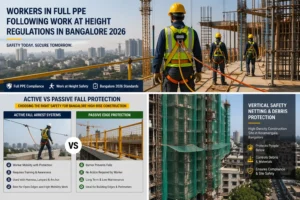
As Bangalore’s skyline grows more ambitious, the engineering of safety systems must keep pace. Relying on basic scaffolding is no longer enough for skyscrapers in Whitefield or the Outer Ring Road. A modern fall arrest system in Bangalore is categorized into two distinct types: passive and active protection. Passive systems, such as guardrails and barriers, require no worker intervention to function. Active systems, however, involve equipment that the worker must wear and properly anchor to a secure structure. For high-rise projects, a combination of both is required to meet 2026 safety benchmarks.
Personal Protective Equipment (PPE): The Double-Lanyard Standard
Under the latest safety harness regulations in India, the 2026 standard for high-rise construction specifically mandates the “Double-Lanyard” full-body harness. This requirement is designed to ensure “100% tie-off,” meaning the worker is always connected to a secure anchorage point, even while moving between different sections of the scaffold. A single lanyard leaves a dangerous gap in protection during transitions; the double-lanyard system eliminates this risk entirely.
Every harness must be equipped with a shock absorber to minimize the impact on the human body during a fall. Furthermore, site managers must be trained to recognize the signs of suspension trauma, which can occur if a worker remains hanging in a harness for too long. For major infrastructure projects, like those managed by BMRCL, having a documented rescue plan alongside these PPE requirements is now a non-negotiable part of the daily safety brief.
Safety Netting and Perimeter Guarding
In high-density neighborhoods like Koramangala or Indiranagar, construction doesn’t just happen in isolation—it happens over busy pedestrian paths and public roads. This makes safety netting and perimeter guarding a vital part of the construction safety norms in Bangalore. Debris nets and vertical catch platforms are mandatory to prevent falling objects from reaching ground level, where they could cause third-party injuries or property damage.
2026 guidelines require that these nets be UV-resistant and fire-retardant, given Bangalore’s intense sun and the prevalence of welding work on-site. Perimeter guarding must be robust enough to act as a physical stop for both personnel and equipment. For builders, investing in high-quality vertical netting is a proactive measure against the severe legal liabilities and “Stop-Work” notices that follow a debris-related accident in a public zone.
Key Insight: Passive protection (nets and rails) protects everyone on and around the site, while active protection (harnesses) is the last line of defense for the individual worker. A compliant site uses both simultaneously.
The Hierarchy of Controls: Strategic Risk Management
In the 2026 safety landscape, simply handing out harnesses to workers isn’t a safety strategy; it is a reaction. Professional builders in Bangalore utilize the “Hierarchy of Controls” to manage risks systematically and effectively. This work at height safety strategy follows a specific order of priority: Elimination, Substitution, Engineering Controls, Administrative Controls, and finally, Personal Protective Equipment (PPE). The primary goal is to remove the hazard entirely before relying on a piece of equipment to catch a falling person.
The first and most effective step is Elimination. If a task can be performed at ground level—such as pre-assembling a steel frame before hoisting it into place—the risk of a fall is reduced to zero. If elimination isn’t possible, we move to Substitution, which might involve using a safer method like a long-reach pole for painting rather than climbing a ladder. When work must happen at height, Engineering controls become the priority. This includes installing collective protection like permanent guardrails or utilizing Mobile Elevated Work Platforms (MEWPs) that provide a secure, enclosed cage for the worker.
For instance, on a commercial site in Sarjapur, a project manager might choose to install a roof-top parapet wall early in the construction phase. This engineering control creates a permanent barrier, significantly reducing the need for temporary scaffolding or individual harnesses for subsequent roofing work. Only after these higher-level controls are exhausted should you rely on administrative protocols (like restricted access signage) and individual PPE (harnesses).
Key Insight: Always prioritize collective protection over individual protection. An engineering control like a guardrail protects every person on the site simultaneously, whereas a harness only protects the one person wearing it correctly.
Bangalore-Specific Challenges: Monsoons and High-Density Sites
In the unique urban fabric of Bengaluru, construction safety is as much about managing the environment as it is about engineering. The Greater Bengaluru (Amendment) Regulations, 2026 have significantly impacted how we build, allowing for increased residential density and raising building heights to 15 meters on smaller plots. This densification creates high-density sites where the margin for error is non-existent. In neighborhoods like Koramangala and Indiranagar, where buildings are often separated by minimal setbacks, urban construction risks include not just on-site falls, but the potential for debris to strike neighboring properties or pedestrians on narrow 9-meter roads.
Monsoon Safety and Soil Stability
The Bengaluru monsoon presents a dual threat: heavy rainfall and rapid soil saturation. Under the 2026 BBMP safety guidelines, builders must account for “post-restoration subsidence” and foundation instability. Because the new GBA rules mandate that setback areas remain unpaved to allow for rainwater percolation, the soil around the base of a scaffold can quickly become unstable.
During these months, monsoon safety protocols must include:
- Daily Foundation Checks: Ensuring that base jacks have not shifted due to soil softening.
- Electrical Hazard Mitigation: Keeping all power cables and distribution boards elevated and shielded from water to prevent shocks on wet scaffolding frames.
- Debris Net Maintenance: Ensuring that heavy rains do not cause “water pooling” in debris nets, which can add tons of unexpected weight to the structure.
Wind Speed Limits for Urban Scaffolds
High-velocity winds are an intensifying factor for high-rises in North Bengaluru, particularly around Hebbal and Devanahalli. As buildings act as massive sails, they catch “vortex-shedding” winds that can destabilize even the most robust scaffolds. According to the 2026 updates to IS 875 (Part 3), builders must observe strict wind speed limits. When gusts exceed 50 km/h, all work at height must be suspended. In these high-exposure zones, we often recommend the use of “permeable” safety mesh rather than solid tarps to reduce the “sail effect” and prevent the scaffold from being pulled away from the building anchor points.
Key Insight: In 2026, BBMP inspectors are increasingly using drones to monitor perimeter safety and net integrity during monsoon storms. A single loose net or an unsecured platform can now be detected remotely, leading to automated citations and site shutdowns.
Documentation & Audits: The Paper Trail of Compliance
In the eyes of a labor inspector, if a safety check isn’t documented, it effectively never happened. Maintaining a rigorous “paper trail” is what separates a professional, law-abiding site from a high-risk liability during a construction safety audit in Bangalore. In 2026, the Karnataka Labor Department has moved toward digital compliance logs, meaning builders must be ready to present verified safety data at a moment’s notice, often via specialized construction management portals.
The foundation of this documentation is the Work at Height Permit (PTW). This is not just a formality; it is a live document that confirms a specific area has been inspected and deemed safe for a specific timeframe. Alongside this, every worker on-site must have a record of a safety induction. This document proves that the individual has been briefed on the specific hazards of the Bangalore site, including the location of emergency exits and the correct use of fall arrest systems.
Mandatory Documents for BBMP and Labor Inspections
When an inspector arrives for an audit, they typically look for a “Safety Master File.” To stay compliant, your site office should have the following five documents organized and updated:
- Valid Work at Height Permits: Signed by the Competent Person for every active high-rise zone.
- Safety Induction & Training Logs: Proof that every worker, including sub-contractors, has received height-safety briefing.
- Third-Party Inspection (TPI) Reports: Independent structural certificates for scaffolds exceeding 15 meters.
- Daily Inspection Checklists: Signed records showing that base plates, ties, and guardrails were checked before the shift began.
- Equipment Fit-for-Purpose Certificates: Documentation showing that safety harnesses and lifelines are within their “use-by” date and have been tested for load capacity.
Key Insight: A successful construction safety audit in Bangalore is won before the inspector even arrives. By digitizing these records and ensuring they are updated daily, you eliminate the frantic “last-minute filing” that often signals poor safety culture to an experienced auditor.
Legal Penalties & Liability for Non-Compliance in 2026
In 2026, the Karnataka Labor Department has shifted from a policy of “warning first” to one of “strict enforcement.” For developers and contractors, a single instance of work at height violations in Karnataka can lead to immediate and severe consequences. Under the revised BOCW (Building and Other Construction Workers) Act, the legal liability doesn’t just stop at the subcontractor; it extends directly to the principal employer or developer. This “joint and several liability” ensures that everyone in the project chain has a financial and legal stake in site safety.
The financial impact of BOCW penalties has increased significantly to account for inflation and to act as a stronger deterrent. Fines for safety lapses can now run into several lakhs per day for large-scale projects. More importantly, authorities have the power to issue a “Prohibition Notice,” which leads to an immediate project shutdown. Beyond the fines, the most serious cases involve charges of criminal negligence in the event of a fatal accident. In such scenarios, project managers and safety officers can face non-bailable warrants if it is proven that mandatory height safety protocols—like the 1.8-meter rule or certified anchorage—were willfully ignored.
Common Mistakes: Why Bangalore Sites Get “Stop-Work” Notices
Through our analysis of site audits in 2026, we have identified three recurring failures that almost always result in an immediate government-ordered shutdown:
- Unauthorized Scaffolding Modifications: Workers removing cross-braces or guardrails to move materials more easily. If an inspector sees a “missing” rail on a live platform, the site is flagged immediately.
- Missing “Competent Person” Supervision: Not having a certified safety supervisor on-site during high-risk activities. A supervisor’s absence during a pour or a lift is a major compliance breach.
- Use of Uncertified PPE: Utilizing cheap, non-ISI marked harnesses or expired lifelines. In 2026, inspectors verify the QR codes on safety gear to ensure they meet current testing standards.
Key Insight: The cost of a 10-day project shutdown in a high-interest market like Bangalore far outweighs the cost of hiring a premium safety consultancy or buying high-grade equipment. Proactive compliance is your most effective budget-protection tool.
FAQs: What Builders Ask About Height Safety
In the rapidly evolving 2026 construction sector, site supervisors and developers often face confusion regarding the specific legalities of height safety. This height safety FAQ for Bangalore addresses the most common queries to help your team stay compliant and navigate the complexities of modern safety audits.
Q: What is the mandatory height for fall protection on Bangalore construction sites? A: Under the 2026 Karnataka state mandates, any activity performed at or above 1.8 meters (6 feet) requires mandatory fall protection. This applies whether you are on a permanent floor edge, a temporary scaffold, or a mobile platform.
Q: Are safety harnesses mandatory for all scaffolding work? A: Yes. If the working height exceeds the 1.8-meter threshold, a safety certification compliant full-body harness is required. In Bangalore, Tier-1 projects and infrastructure works like the Namma Metro now specifically mandate “double-lanyard” harnesses to ensure 100% tie-off at all times during movement.
Q: What are the current labor fines for height safety violations in Karnataka? A: In 2026, labor fines for non-compliance have become significantly more stringent to act as a deterrent. Minor violations can attract fines starting from ₹50,000, while major lapses that pose life-threatening risks can result in penalties of several lakhs per day and immediate project suspension by the Labor Department.
Q: Can a site supervisor also act as the “Competent Person” for safety? A: Only if they hold a recognized safety certification and have the technical expertise to identify fall hazards. The law requires this individual to have the explicit authority to stop work immediately if a violation is spotted.
Q: How do 2026 regulations prioritize safety nets versus harnesses? A: Regulations follow the “Hierarchy of Controls,” which prioritizes “Collective Protection” (like safety nets and guardrails) over individual protection (harnesses). However, for most high-rise sites in Bangalore, both systems are required to be used in tandem to provide a multi-layered safety net for workers and the public.
Key Insight: For high-stakes projects, always keep a copy of your safety certificates and equipment test reports digitally accessible. AI-driven audits by government bodies now require instant verification of these documents during surprise inspections.
Practical Action Steps for Bangalore Builders: 2026 Checklist
To transition from legal awareness to on-site safety, project managers must implement a systematic construction safety action plan in Bangalore. In a high-stakes environment where a single oversight can lead to a project shutdown, these practical steps ensure that your site remains both compliant and productive. Safety is not a one-time setup; it is a daily discipline that requires continuous monitoring and leadership engagement.
Here is your immediate 2026 compliance roadmap:
- Conduct a 1.8-Meter Gap Analysis: Walk your site and identify every location where work is performed above the legal threshold. Ensure that these areas have either certified perimeter guarding or active lifelines installed.
- Verify Equipment Inventory: Inspect your fall arrest systems and PPE. Any harness or lanyard showing signs of fraying, or any equipment that has reached its manufacturer-recommended “end-of-life” date, must be decommissioned and replaced with ISI-marked alternatives.
- Formalize the Safety Induction: Ensure that every new worker—especially migrant labor or sub-contractor crews—undergoes a mandatory height-safety briefing. This should include a practical demonstration of how to correctly wear and clip a double-lanyard harness.
- Digitize Your Permit System: Move away from paper logs. Use a digital platform to issue and track “Work at Height Permits.” This creates a timestamped audit trail that is invaluable during surprise inspections by BBMP or the Labor Department.
- Establish a Rescue Protocol: Having a harness isn’t enough. You must have a documented plan for retrieving a suspended worker within 15 minutes to prevent suspension trauma.
Key Insight: Safety is an investment in your project’s uptime. By treating these Practical Action Steps as core operational tasks rather than “extra” work, you protect your workers’ lives and your company’s reputation in Bangalore’s competitive real estate market.
Conclusion: Elevating Safety Standards in Bangalore’s Skyline
As Bangalore continues its vertical expansion into 2026, the complexity of managing high-rise projects demands a shift from basic site management to advanced regulatory compliance. Adhering to the work at height regulations in Bangalore is no longer just a legal hurdle; it is a hallmark of a professional, tier-1 builder. By integrating the BOCW Act’s mandates, mastering the hierarchy of controls, and ensuring every worker is protected by a certified fall arrest system, you aren’t just avoiding penalties—you are building a brand defined by reliability and safety.
The future of construction in Karnataka belongs to those who view safety as a strategic asset. While the initial investment in high-quality PPE and digital permit systems may seem significant, the long-term returns in project “uptime,” reduced insurance premiums, and a motivated workforce are far greater. Whether you are navigating the monsoons or managing high-density sites in the city center, let compliance be your guide. For a deeper dive into the technical specifications of the structures supporting your workers, refer to our comprehensive guide on scaffolding safety standards in India.
Key Takeaway: In 2026, safety excellence is the ultimate competitive advantage. A site that prioritizes the lives of its workers is a site that delivers quality on time, every time. Stay informed, stay compliant, and keep building the future of Bangalore safely.

About Sri Kanakadri Scaffolding Author – Sri Kanakadri provide Bangalore’s most reliable scaffolding on rental services, offering safe, cost-effective, and top-quality scaffolding rental solutions for all construction projects. With years of expertise, Sri Kanakadri Scaffolding is committed to delivering exceptional scaffolding on rental services in Bangalore that exceed client expectations. Our focus is on safety, quality, and affordability for every construction project. e specialize in scaffolding hire in Bangalore, offering reliable and cost-effective scaffolding rental solutions tailored to your needs. From construction scaffolding services to industrial scaffolding on rent, we ensure precision, safety, and efficiency in every project. Trust us for affordable scaffolding rentals that guarantee unmatched professionalism and reliability.