
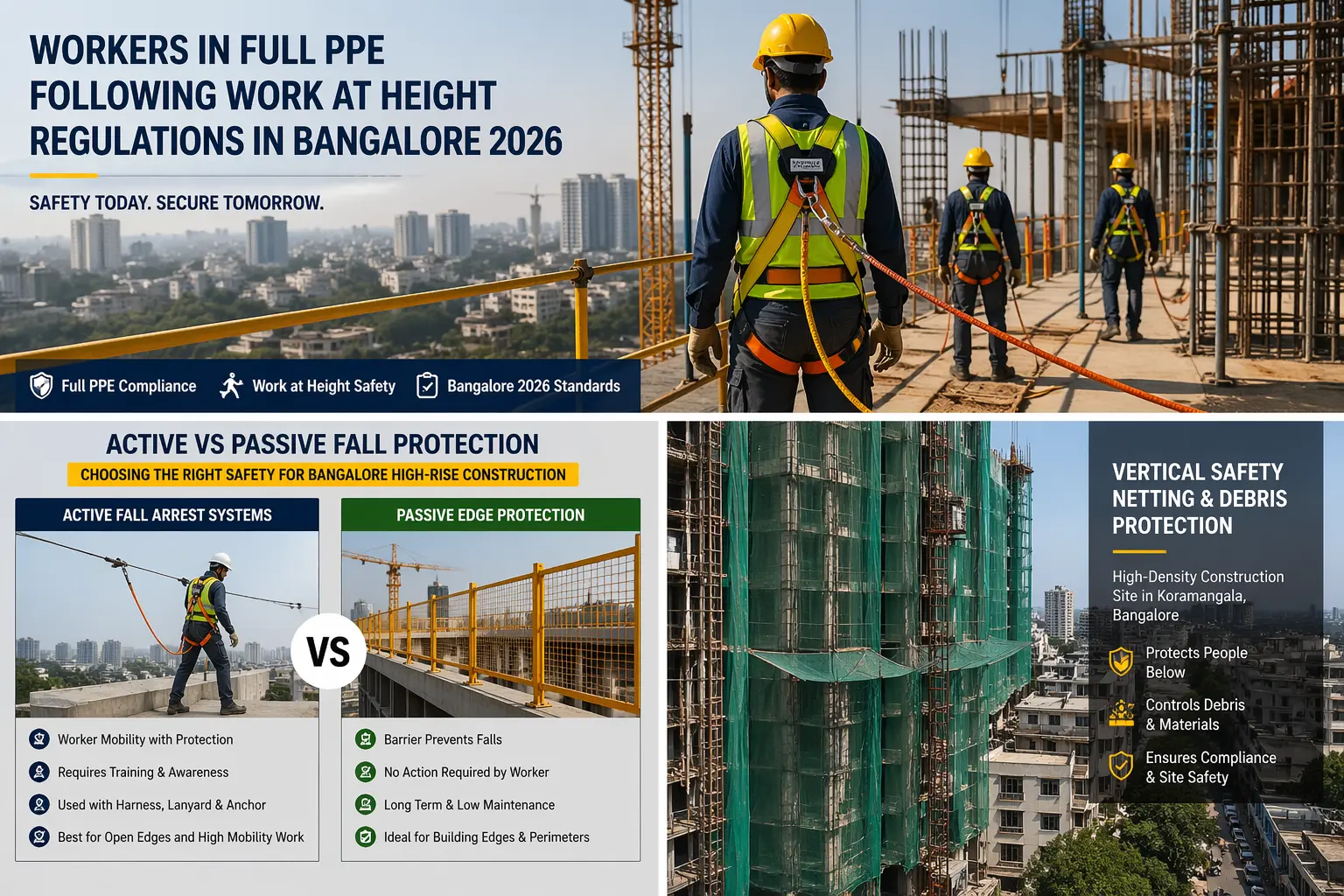
Work at Height Regulations 2026: Mandatory Safety Norms for Bangalore Builders
In Bangalore’s race to the sky, the cost of negligence is higher than ever. With the Karnataka government tightening enforcement of the BOCW Act in 2026, understanding work at height regulations in Bangalore is no longer just about safety—it’s about legal survival. Whether you are developing tech parks in Whitefield or high-rise residential towers in Hebbal, strict compliance is the only way to protect both your workforce and your business. This guide breaks down the mandatory norms, from BBMP bylaws to advanced fall arrest systems, ensuring your project stays compliant and your sites remain accident-free. The Regulatory Landscape: BOCW Act & Karnataka State Rules Navigating the legal framework for construction safety in India has historically been a challenge due to overlapping regulations. However, 2026 marks a pivotal shift with the implementation of the Occupational Safety, Health and Working Conditions (Karnataka) Rules, 2026. This new mandate consolidates several older statutes, including the central BOCW Act 1996, into a unified state-level enforcement strategy. For builders in Bangalore, this means that compliance is no longer a “check-the-box” activity but a strictly monitored digital and physical requirement overseen by the Karnataka Labor Department. Under the updated work at height laws India 2026, the focus has shifted from mere guidelines to mandatory safety infrastructure. The rules now demand that every project of significant scale must establish a dedicated Safety Committee and appoint a qualified Safety Officer. These officers are legally responsible for ensuring that all site activities align with the latest National Building Code (NBC) standards. Failure to adhere to these Karnataka Labor Laws can lead to immediate work-stop orders and significant financial penalties, making it essential for developers to integrate safety planning into the very first phase of project mobilization. Understanding the 1.8-Meter Trigger Point One of the most critical aspects for site supervisors to grasp is the legal definition of “working at height.” In the 2026 regulatory environment, the “1.8-meter rule” remains the primary trigger point for mandatory safety intervention. According to the mandatory fall protection guidelines Karnataka, any task performed where a worker could potentially fall a distance of 1.8 meters (approximately 6 feet) or more requires the immediate installation of certified fall arrest systems or edge protection. This threshold is not arbitrary; it is the point where the risk of serious injury increases exponentially. On a typical Bangalore site—whether it’s a residential villa in Sarjapur or a metro pier cap on the Outer Ring Road—reaching this height mandates the use of either “passive” protection (like sturdy guardrails and toe boards) or “active” protection (such as full-body harnesses with secure anchorage). By strictly enforcing the 1.8-meter rule, builders ensure they are compliant with the Working at Height definition used by labor inspectors during surprise site audits, effectively shielding the project from both physical accidents and legal liability. Key Insight: Never assume a “small” height is safe. Labor inspectors in Bangalore now use the 1.8-meter mark as the baseline for issuing safety citations. If your platform is at head height, your safety gear must be on. Mandatory Fall Protection Systems for Bangalore High-Rises As Bangalore’s skyline grows more ambitious, the engineering of safety systems must keep pace. Relying on basic scaffolding is no longer enough for skyscrapers in Whitefield or the Outer Ring Road. A modern fall arrest system in Bangalore is categorized into two distinct types: passive and active protection. Passive systems, such as guardrails and barriers, require no worker intervention to function. Active systems, however, involve equipment that the worker must wear and properly anchor to a secure structure. For high-rise projects, a combination of both is required to meet 2026 safety benchmarks. Personal Protective Equipment (PPE): The Double-Lanyard Standard Under the latest safety harness regulations in India, the 2026 standard for high-rise construction specifically mandates the “Double-Lanyard” full-body harness. This requirement is designed to ensure “100% tie-off,” meaning the worker is always connected to a secure anchorage point, even while moving between different sections of the scaffold. A single lanyard leaves a dangerous gap in protection during transitions; the double-lanyard system eliminates this risk entirely. Every harness must be equipped with a shock absorber to minimize the impact on the human body during a fall. Furthermore, site managers must be trained to recognize the signs of suspension trauma, which can occur if a worker remains hanging in a harness for too long. For major infrastructure projects, like those managed by BMRCL, having a documented rescue plan alongside these PPE requirements is now a non-negotiable part of the daily safety brief. Safety Netting and Perimeter Guarding In high-density neighborhoods like Koramangala or Indiranagar, construction doesn’t just happen in isolation—it happens over busy pedestrian paths and public roads. This makes safety netting and perimeter guarding a vital part of the construction safety norms in Bangalore. Debris nets and vertical catch platforms are mandatory to prevent falling objects from reaching ground level, where they could cause third-party injuries or property damage. 2026 guidelines require that these nets be UV-resistant and fire-retardant, given Bangalore’s intense sun and the prevalence of welding work on-site. Perimeter guarding must be robust enough to act as a physical stop for both personnel and equipment. For builders, investing in high-quality vertical netting is a proactive measure against the severe legal liabilities and “Stop-Work” notices that follow a debris-related accident in a public zone. Key Insight: Passive protection (nets and rails) protects everyone on and around the site, while active protection (harnesses) is the last line of defense for the individual worker. A compliant site uses both simultaneously. The Hierarchy of Controls: Strategic Risk Management In the 2026 safety landscape, simply handing out harnesses to workers isn’t a safety strategy; it is a reaction. Professional builders in Bangalore utilize the “Hierarchy of Controls” to manage risks systematically and effectively. This work at height safety strategy follows a specific order of priority: Elimination, Substitution, Engineering Controls, Administrative Controls, and finally, Personal Protective Equipment (PPE). The primary goal is to remove the hazard entirely before relying on a piece of equipment