In heavy civil engineering, you often run into “impossible” spots where ground-based support just isn’t an option. Whether you’re working on a bridge girder hanging over a canal or a building facade jutting out over a busy road, a standard tower won’t cut it. This is where cantilever scaffolding hire Bangalore becomes the only real solution for complex infrastructure.
By using “needles” or outrigger beams that project outward from a stable structure, cantilever systems let your crew work safely over obstacles without needing a single pole on the ground. This guide breaks down the engineering and safety protocols needed to handle these high-stakes setups without the usual fluff.
In a fast-growing city like Bangalore, you need solutions that don’t choke traffic or wreck existing landscapes. Cantilevered systems solve this by shifting the weight from the ground to a secure host structure. We’ll look at how these systems work, the 2026 safety mandates you need to follow, and how to keep your site compliant while reaching those tough zones.
Key Insight: Cantilever scaffolding isn’t a “one-size-fits-all” product; it’s an engineered solution. Its success depends entirely on the strength of the anchor point and the math behind the load.
The Engineering of Projection: What is Cantilever Scaffolding?
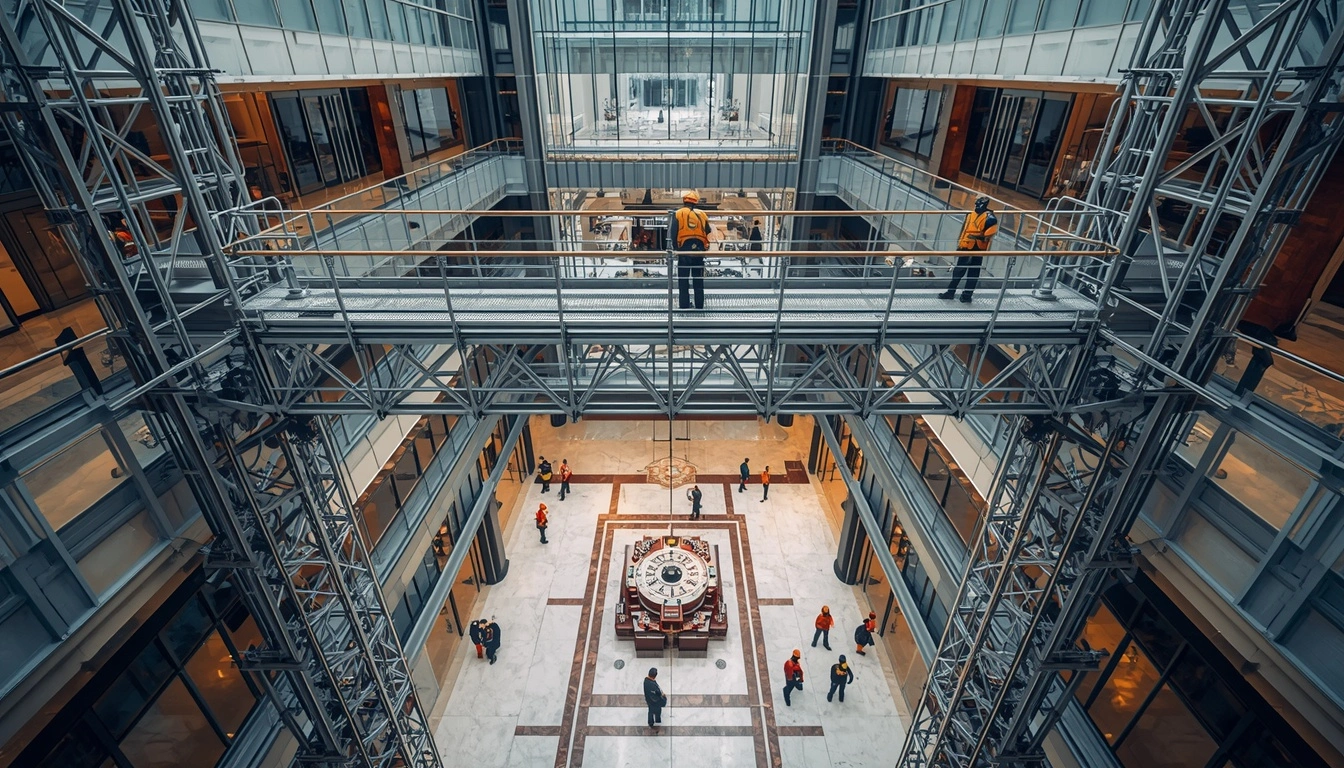
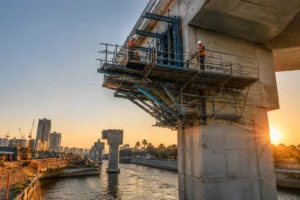
Cantilever scaffolding is a specialized setup that projects horizontally from a building. Unlike towers that sit on a base, a cantilevered scaffold rental relies on the building itself for support. The platform sits on horizontal beams called needles that are anchored into the floor or wall. This creates a protruding scaffold that reaches high-altitude areas where ground support is blocked by water, fragile roofs, or heavy traffic.
The core idea is “leveraged support.” By securing one end of a beam inside the structure, the other end sticks out to create a stable walkway. This is why choosing your structural support is so important; the anchor points have to handle both the downward weight of the crew and the upward “uplift” force inside the building.
Needle Scaffolding vs. Outrigger Systems: Key Differences
When looking for needle scaffolding services, you need to know the two ways we project a platform. Both do the same job but fit different scenarios:
- Needle Scaffolding: The most common form. It involves passing a beam (the needle) through a hole in the wall or a window. The beam is anchored to the floor slab inside, providing a rock-solid fulcrum for the platform outside.
- Outrigger Systems: These are used when you can’t pierce the wall. Instead, the outrigger beams are secured to a base frame or floor and extended over a ledge. You’ll see this often in modern glass-facade buildings where drilling through the exterior is forbidden.
Key Insight: Outrigger systems are faster to set up, but needle scaffolding usually handles heavier loads for serious infrastructure repairs.
When to Choose Cantilever Systems for Infrastructure Projects
Standard scaffolding needs a flat, solid foundation, but real-world infrastructure is rarely that clean. You should choose scaffolding for hard to reach areas when ground-level obstacles make a traditional tower dangerous or impossible. For example, if you’re doing bridge maintenance over a river or a railway, you can’t exactly put poles in the water or on the tracks.
These systems are also perfect for urban congestion. In a crowded site, the ground might be packed with utilities, machines, or pedestrians. By projecting the scaffold from an upper floor, you bypass the mess entirely and keep the site moving.
Overcoming Road & Water Obstacles in Bangalore’s Expansion
For Bangalore infrastructure, cantilevered solutions are non-negotiable. We often see a need for cantilever scaffolding for bridge repair on flyovers crossing drainage canals. In these spots, the soft soil makes ground support a recipe for disaster.
As Metro projects move over existing roads, keeping road clearance open is a legal must. Cantilevered platforms let workers reach pier caps without stopping the traffic below. It’s the only way to balance fast development with daily city logistics.
Key Insight: Use a cantilever system when the cost of clearing the ground (time, permits, or safety risks) is higher than the cost of an overhead solution.
The Physics of Balance: Load Calculations & Anchor Points
Success in cantilever scaffolding design isn’t about guessing; it’s pure physics. Because these structures hang in open space, they act like giant levers. Every bit of weight on the outside creates an “uplift” force inside. Managing the gap between the fulcrum point (the building’s edge) and the structural anchorage is the secret to a safe site.
To keep things from tipping, we use a strict safety factor of at least $4:1$. This means the internal tie-down force must be four times the maximum weight expected on the platform. We calculate the “moment of force” by multiplying the weight by its distance from the edge.
In high-rises, we often use mechanical bolts that tie into the concrete slab rather than just using dead weights. This ensures the anchor can handle “uplift” during high winds or accidental overloading.
Key Insight: The “invisible” part of the scaffold inside the building is the most critical. If the internal anchor doesn’t meet the safety ratio, the whole thing is a hazard.
2026 Safety Mandates for Protruding Scaffolding Structures
By 2026, the rules for working at height in India have become much tighter. For safety standards for cantilevered scaffolds 2026, “good enough” won’t pass inspection. The updated IS 3696 compliance now focuses heavily on how beams are secured.
One big change: makeshift counterweights are banned. You can no longer use sandbags, bricks, or water tanks. Today, you must use certified, heavy-duty iron weights or mechanical floor anchors that can be verified with a torque wrench.
Inspectors now look for “positive locking” at the anchor point. The beam must be bolted or clamped to the structure so it can’t move an inch. Also, a structural engineer must certify that the building can handle the force at the fulcrum. If the concrete is old or weak, the setup is a no-go until you add a secondary support frame.
Key Insight: Safety in 2026 is about a paper trail. From the torque on the bolts to the weight of the plates, everything must prove it meets the $4:1$ safety ratio.
Vetting your Rental Partner: Why Certification is Non-Negotiable
With cantilever scaffolding hire Bangalore, you aren’t just renting pipes; you’re hiring engineering. Because these systems rely on physics rather than ground poles, there’s no room for mistakes. A professional partner should give you a full safety audit and stamped technical drawings showing exactly how they plan to anchor the rig.
At Sri Kanakadri Scaffolding, we treat every cantilever job as a unique puzzle. We make sure all certified equipment from beams to high-tensile bolts is logged before it hits your site. A good vendor will always demand a site visit first. If a company offers to just drop off a “cantilever kit” without seeing your building, send them away.
This level of detail is why we are leaders in advanced infrastructure scaffolding Bangalore. We prioritize the math so you don’t have to worry about a structural collapse.
Common Errors in Cantilever Setup (and How to Avoid Them)
Most scaffolding safety mistakes happen when people ignore the physics of leverage. Because there’s no vertical support at the outer edge, small errors become big problems fast.
- Wrong Counterweights: If weights aren’t locked in a cage, they can shift. If they shift, the platform drops. Use only fixed, certified weights.
- Poor Anchorage: Never assume a concrete floor is strong enough. Check for cracks. If the bolts are too short or too close to the edge, the slab can fail under pressure.
- Overloading: Workers often treat a cantilever like a regular tower. It’s not. These platforms have a much lower “live load” capacity. Stacking heavy steel or cement on the edge is a fast way to break the $4:1$ safety ratio.
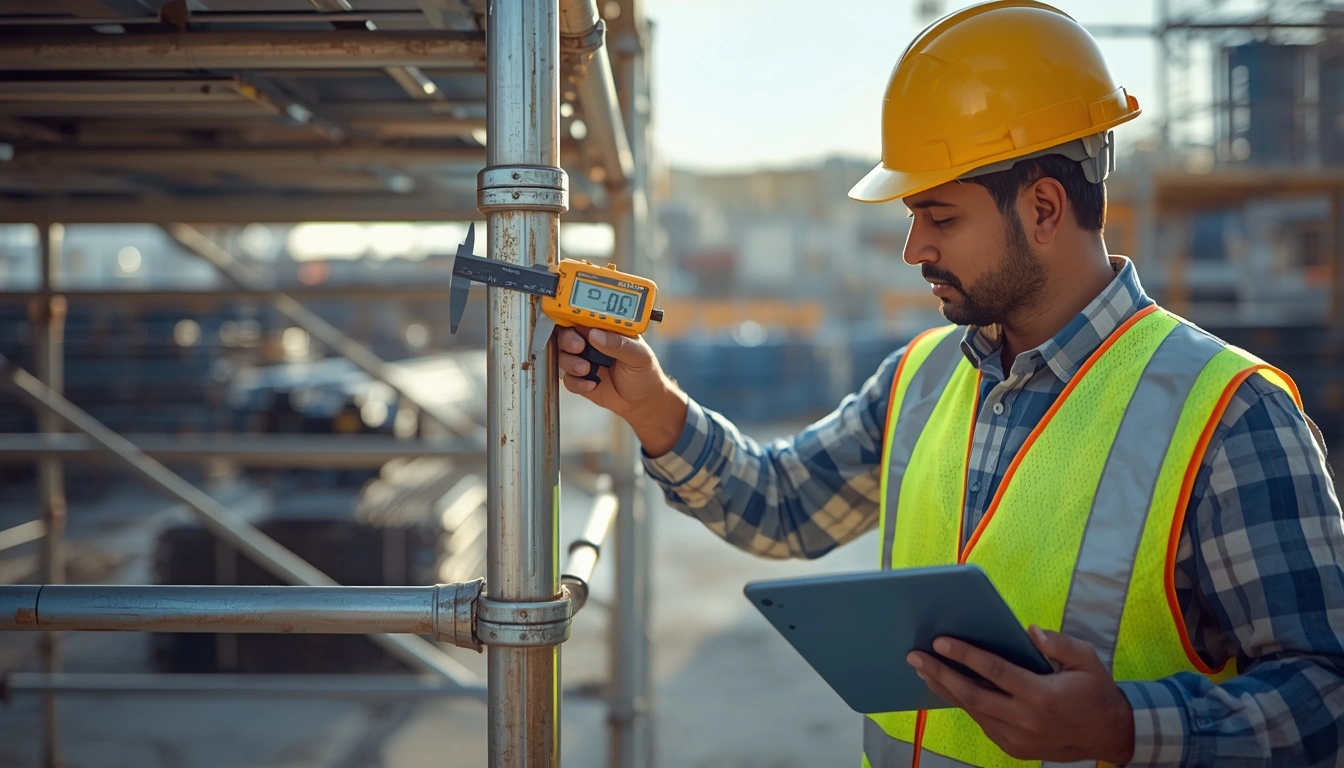
Key Insight: If a setup looks “improvised,” it’s dangerous. Always use a daily scaffolding inspection checklist to spot red flags like loose weights or cracked anchor points.
FAQs: Technical Queries on Cantilever Scaffolding
What is the typical cantilever scaffolding cost in Bangalore?
The cantilever scaffolding cost is higher than standard towers because you’re paying for engineering design and high-tensile materials. The price usually depends on how far the platform sticks out.
How does the rental duration work?
Most agreements are monthly. Since setup takes longer, long-term rentals are common for infrastructure projects to keep the daily costs down.
What are the load limits?
They are lower than ground scaffolds. They are meant for light-to-medium work like painting or facade repair, not for storing heavy materials.
How much installation time is needed?
Expect it to take 2–3 times longer than a standard tower. Every anchor has to be torque-tested to meet the work at height regulations Bangalore 2026.
Action Steps: Your Safe Access Plan
- Site Audit: Have an engineer check the host building’s strength.
- Engineering Design: Create a blueprint showing anchor placement and torque specs.
- Verify Compliance: Conduct a “Pull Test” on anchors before anyone goes up.
By following these steps and working with a specialist like Sri Kanakadri Scaffolding, you ensure your project stays on track and stays safe. Don’t guess with lateral access stick to the physics.
Key Insight: A good cantilever project is 70% planning. The more work you do in the audit, the smoother the install will go.
Contact Sri Kanakadri Scaffolding today for professional rental solutions and expert safety guidance tailored to your Bangalore project.
Phone: +91 9113276916
Visit our Google My Business Listing for Directions

About Sri Kanakadri Scaffolding Author – Sri Kanakadri provide Bangalore’s most reliable scaffolding on rental services, offering safe, cost-effective, and top-quality scaffolding rental solutions for all construction projects. With years of expertise, Sri Kanakadri Scaffolding is committed to delivering exceptional scaffolding on rental services in Bangalore that exceed client expectations. Our focus is on safety, quality, and affordability for every construction project. e specialize in scaffolding hire in Bangalore, offering reliable and cost-effective scaffolding rental solutions tailored to your needs. From construction scaffolding services to industrial scaffolding on rent, we ensure precision, safety, and efficiency in every project. Trust us for affordable scaffolding rentals that guarantee unmatched professionalism and reliability.