
Executing large-scale infrastructure projects across India requires massive capital, making heavy machinery acquisition a critical financial bottleneck. For procurement managers and CFOs, relying on strategic construction equipment leasing India models has become the absolute standard to preserve liquid capital and maintain operational agility. Whether your project requires heavy earthmovers or specialized scaffolding on rental options, shifting from outright asset ownership to a B2B agreement introduces complex legal compliance, liability distributions, and tax frameworks that can expose your business to severe risk if improperly structured. This guide breaks down the essential legal guardrails, contract rules, and procurement strategies required to secure your assets safely and keep your projects moving.
The Legal Framework: Equipment Leasing as Bailment
Unlike many Western nations, India does not have a single, dedicated legal statute governing the rental of heavy machinery. Instead, the foundation of all equipment rental contract rules in the country is based on the concept of “bailment” governed by the Indian Contract Act, 1872.
When your procurement team signs a rental agreement for an excavator or a specialized scaffolding system, a contract of bailment is legally formed. Within this framework, the owner of the machinery (the leasing vendor) is known as the bailor (or lessor), and the construction firm using the asset is the bailee (or lessee).
Under these rules, both parties hold strict legal duties. The lessor is obligated to deliver the equipment in safe, operational condition and ensure the lessee enjoys “peaceful possession” throughout the rental period without unnecessary interference. Conversely, the lessee is legally required to take reasonable care of the machinery, use it strictly for the agreed-upon construction purpose, adhere to the payment schedule, and return the asset safely at the end of the term.
Key Insight: Because India lacks a universal “Leasing Act,” the specific terms drafted into your individual contract carry immense weight. If a piece of equipment is damaged on your site, the courts will look directly at how your specific bailment clauses assigned liability.
Operating Leases vs. Finance Leases in Construction
When executing operating vs finance lease for construction machinery strategies, procurement managers must choose the structural format that best aligns with their project timeline and balance sheet requirements. In the Indian construction sector, leases are almost universally categorized into two distinct types, each carrying entirely different financial and contractual implications.
1. Operating Leases (Short-Term Operational Flexibility)
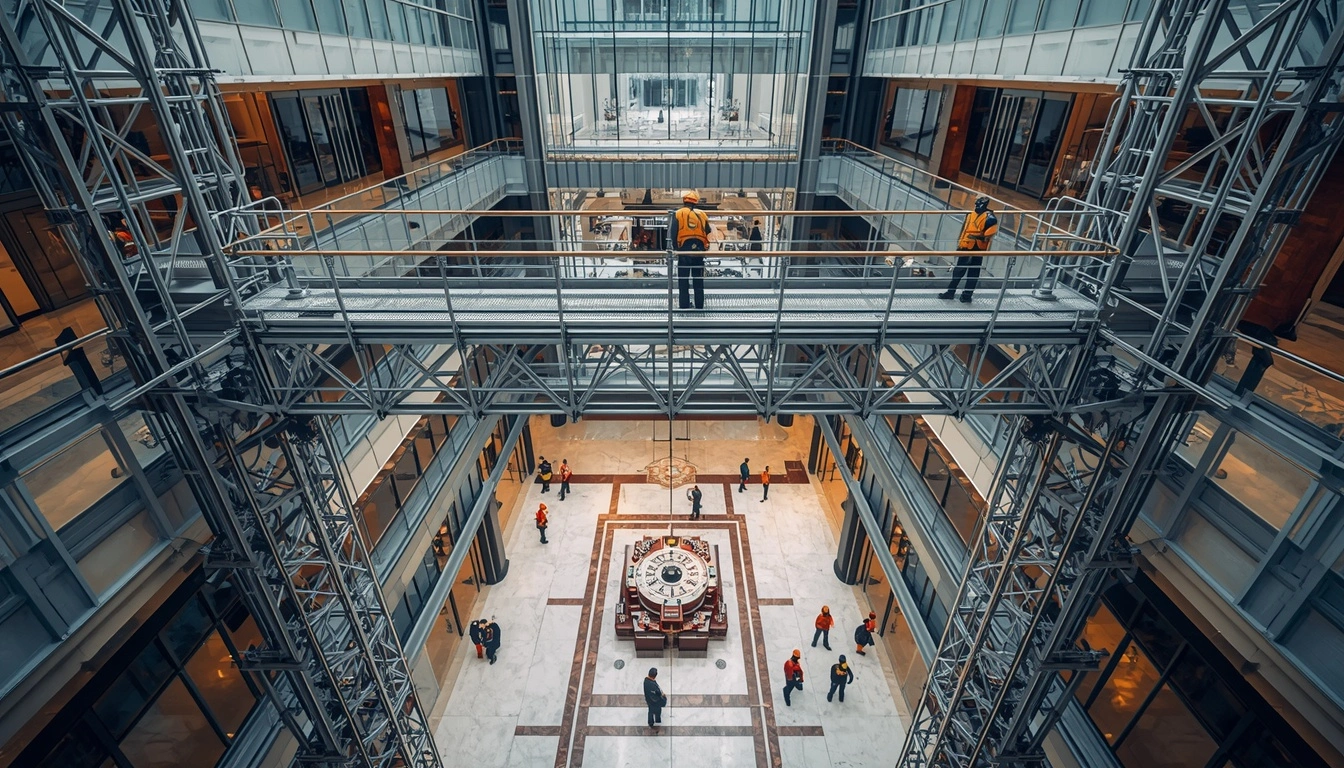
An operating lease functions much like a traditional, short-term rental agreement. This model is highly favored for specialized machinery needed only for specific project phases such as deploying a custom rolling bridge scaffolding in Bangalore for high-ceiling atrium maintenance or utilizing transit mixers for a specific concrete pour.
Under an operating lease, the ownership risks and rewards remain strictly with the leasing company (the lessor). The construction firm (the lessee) rents the asset for a fraction of its useful life. Once that project phase wraps up, the machinery goes back to the vendor. Crucially, because these agreements do not transfer ownership rights, they traditionally sit differently on corporate balance sheets, keeping your debt-to-equity ratios optimized.
2. Finance Leases (Long-Term Asset Acquisition)
A finance lease (often called a capital lease) operates more like a structured loan agreement disguised as a rental contract. This model is typically deployed for core fleet assets that your firm intends to use across multiple long-term infrastructure projects over several years.
In a finance lease, the contract duration covers most of the machinery’s economic lifespan. While the leasing company retains legal ownership during the term, virtually all operational risks, insurance costs, and maintenance burdens shift entirely to your construction firm. The defining feature of a finance lease is the inclusion of a purchase option at the tail end of the contract, allowing your business to formally acquire ownership transfer of the asset for a nominal fee once the lease term expires.
Essential Clauses Every B2B Equipment Rental Contract Needs
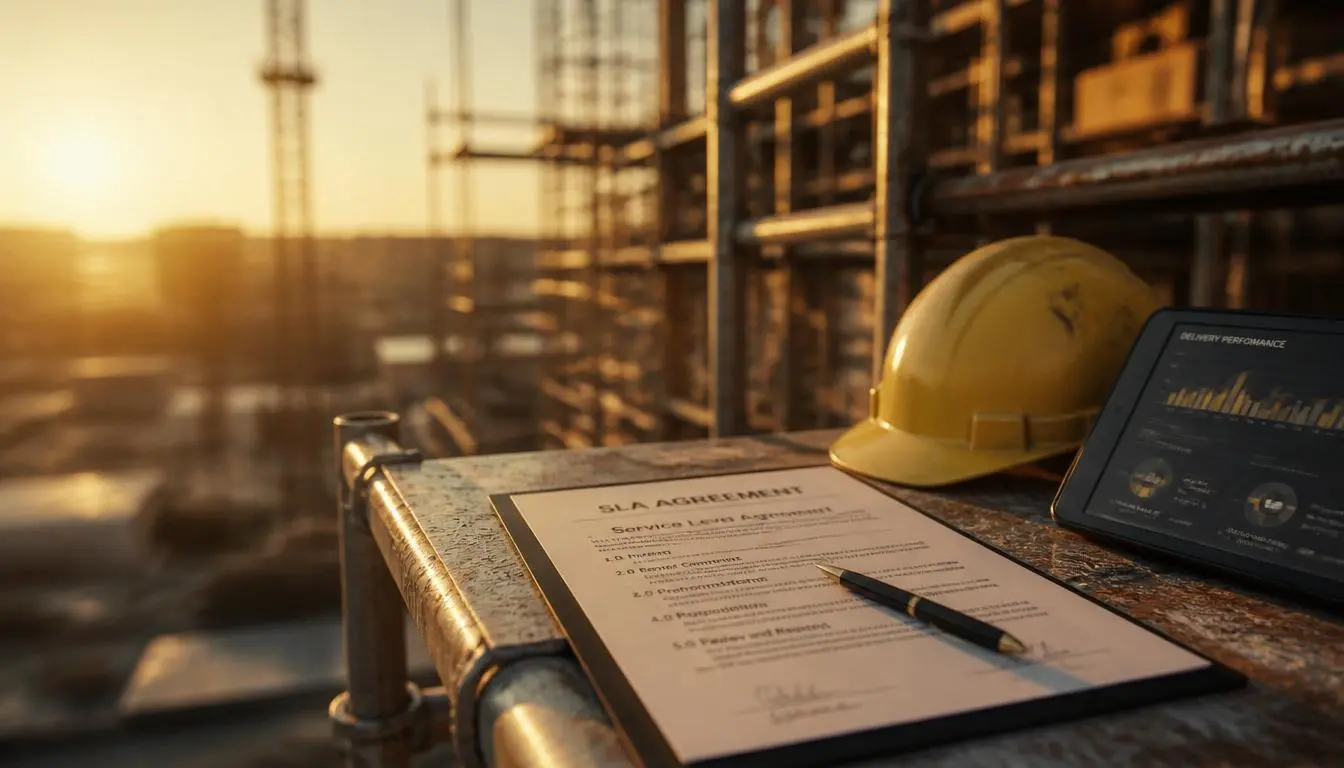
Mitigating operational and financial risks in heavy machinery procurement requires a rock-solid B2B equipment lease agreement. Because construction environments are inherently volatile, relying on generic rental templates can expose your business to massive liabilities. Whether your team is securing a heavy-duty cuplock scaffolding rental setup or a fleet of excavators, a properly engineered contract must clearly define where the responsibilities of the owner end and those of your construction firm begin.
To prevent costly legal disputes and protect your project margins, ensure your legal and procurement teams verify that the following core clauses are explicitly detailed before signing:
- Detailed Asset Identification: The contract must specify exact serial numbers, model numbers, manufacturer details, and the current operational hour-meter readings of the machinery at the exact moment of handover.
- Defined Lease Term and Extension Rules: Establish clear boundaries for the commencement date, expected termination date, and precise grace periods for demobilization. Include predetermined rental rates for potential project extensions to avoid sudden price spikes.
- Payment Structures and Grace Periods: Outline the exact invoicing cycle (e.g., monthly advance or milestone-based), accepted modes of payment, interest penalties for delayed payments, and refundable security deposit terms.
- Liability and Risk Allocation: Explicitly state which party bears financial responsibility if the equipment causes property damage, project delays, or structural failures on-site.
- The Indemnification Clause: A mandatory provision protecting your firm from legal claims, lawsuits, or penalties arising from pre-existing mechanical defects, structural failures of the rented equipment, or third-party injuries caused by the vendor’s negligence.
Common Mistake to Avoid: Never sign an agreement with a vague “wear and tear” definition. Standard usage on a dusty, rocky construction site naturally degrades machinery components. The contract must explicitly state that the lessee is not financially liable for normal, gradual degradation of tires, seals, or hydraulic hoses under standard operational conditions.
Tax Implications: Navigating GST and ITC
Managing the financial side of a heavy machinery lease in India requires strict adherence to the Goods and Services Tax (GST) framework. Unlike the outright purchase of capital goods, where tax is paid completely upfront, leasing spreads the tax liability across the entire duration of the rental agreement, providing significant cash flow benefits.
Under the current Indian tax structure, construction equipment leasing or hiring is classified as a “Supply of Service.” It falls primarily under the Services Accounting Code SAC 9973 (Leasing or rental services without operator) or related sub-categories if operators are provided.
1. The GST Rate Structure
The GST rate applied to equipment rentals is tightly bound to the type of lease contract signed:
- Operating Leases and Dry Hirings: Generally attract a standard GST rate of 18%.
- Finance Leases (with Transfer of Right to Use): Are taxed at the same GST rate applicable to the physical supply of the specific machinery itself (which is typically 18% for most earthmoving, scaffolding, and heavy construction equipment).
2. Maximizing Input Tax Credit (ITC)
For procurement managers, the most critical financial advantage of a B2B equipment lease is the eligibility to claim Input Tax Credit (ITC). The 18% GST paid on monthly or milestone-based rental invoices can be fully set off against your output tax liability (the GST your firm charges on your construction or infrastructure bills).
To ensure your finance department can legally claim this credit without triggering audit red flags from the tax department, the leasing vendor must issue flawless, compliant tax invoices. These invoices must correctly reflect your firm’s state-specific GSTIN, the correct SAC code, and the accurate place of supply.
Financial Insight: While the lessee writes off the monthly lease payments directly as an operational business expense to reduce taxable corporate income, the legal ownership remains with the lessor. Therefore, under standard operating lease rules, the leasing vendor is the party entitled to claim the annual depreciation benefits on the physical machinery under the Income Tax Act.
Stamp Duty and Registration Compliance
While GST handles the operational taxation, executing a legally binding contract for construction equipment leasing India requires strict adherence to local documentation laws. An unstamped or under-stamped lease agreement is generally inadmissible as evidence in an Indian court, rendering your carefully negotiated protective clauses effectively useless during a dispute.
Under the Indian legal framework, the payment of state-specific stamp duty is a mandatory prerequisite for any formal equipment lease. Because stamp duty is governed at the state level, the financial obligations vary drastically depending on where the agreement is executed and where the machinery will be deployed. For example, executing a lease agreement for high-specification cleanroom scaffolding or a heavy crane network in Karnataka will attract an entirely different stamp duty calculation compared to a similar contract signed in Maharashtra or Tamil Nadu. Procurement teams must always calculate this expense into the initial acquisition budget.
Furthermore, your legal team must evaluate the duration of the contract against the stipulations of the Registration Act 1908. While short-term project rentals usually bypass this hurdle, if a long-term operational lease or a finance lease extends beyond twelve months, it may require formal registration with the local Sub-Registrar. Failing to properly stamp and register a long-term lease not only invites severe financial penalties but significantly weakens the lessee’s legal rights to peaceful possession of the asset.
Dispute Resolution and Arbitration Strategies
When a high-value asset is damaged on-site or a contractor defaults on monthly payments, resolving the issue through the traditional Indian civil court system is notoriously slow. For procurement managers, having machinery or capital tied up in a multi-year litigation battle is a financial disaster. This is why mastering your equipment rental contract rules regarding dispute resolution is absolutely non-negotiable.
To protect your balance sheet and your project timelines, every B2B lease agreement must include a clearly defined arbitration clause governed by the Arbitration and Conciliation Act 1996. Arbitration allows both the lessor and lessee to bypass overloaded local civil courts and settle grievances privately, swiftly, and with legally binding authority.
A robust arbitration clause must explicitly state the exact seat and venue of the arbitration proceedings and define the specific legal jurisdiction that will handle the matter. Furthermore, the contract should outline the process for appointing a neutral arbitrator to ensure fairness for both parties.
Expert Insight: Never accept a vaguely worded jurisdiction clause. If your construction site is in Karnataka but the leasing vendor is based in Maharashtra, a poorly drafted contract could force your legal team to travel across state lines to fight a dispute. Always lock in a mutually convenient, exclusive jurisdiction before the machinery is dispatched to your site.
Action Steps: Securing Your Procurement Contract
To maximize operational efficiency and fully protect your construction firm from legal or financial exposure, your procurement team should treat contract negotiation as a structured compliance checklist. Before deploying heavy machinery or complex structural platforms to any site in India, ensure you execute these final practical steps:
- Verify the Legal Ownership & Title: Confirm that the leasing vendor holds clear, undisputed ownership of the machinery. This prevents your project from being halted by third-party financial claims or asset repossessions mid-phase.
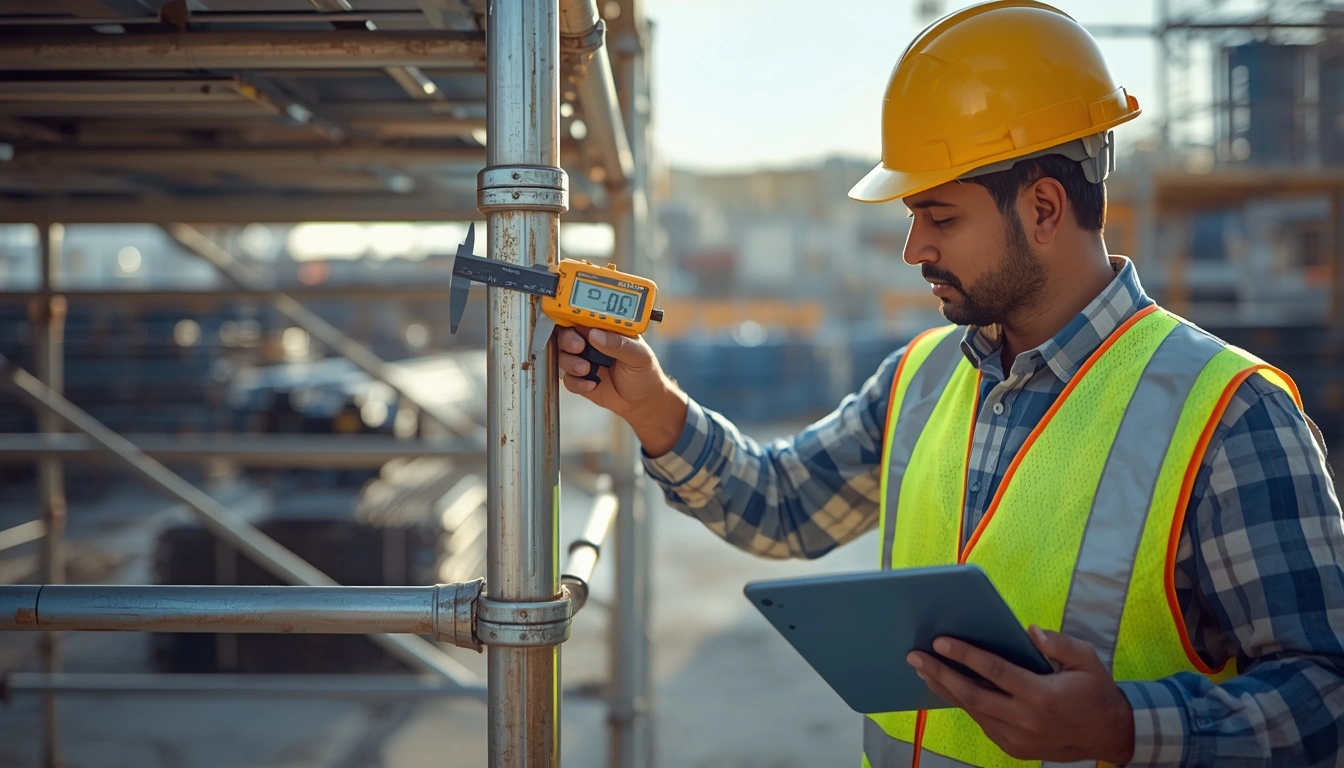
- Conduct an Independent Pre-Handover Inspection: Document the mechanical and structural condition of the equipment with date-stamped photographs and hour-meter logs. Append this report directly to your lease agreement to eliminate “pre-existing damage” disputes during demobilization.
- Audit the Vendor’s Tax Registration: Cross-check the leasing company’s active GSTIN status on the government portal. Ensure they utilize the correct SAC 9973 classification on all recurring invoices so your accounting team can smoothly claim Input Tax Credits (ITC) without triggering audits.
- Review Local Compliance and Logistics Clearances: Confirm that all transport permits, state-specific RTO clearances for heavy machinery, and required operator licenses are fully secured and legally valid for your specific construction site location.
Frequently Asked Questions on Indian Construction Equipment Leasing
To close out this comprehensive pillar guide, here are the direct answers to the most common queries searched by B2B procurement managers and legal teams regarding heavy machinery contracts in India:
1. Who claims depreciation on leased construction equipment in India?
Under an operating lease, the legal ownership of the asset stays entirely with the leasing company (the lessor). Therefore, the lessor is the party entitled to claim annual depreciation benefits under the Income Tax Act. The lessee writes off the monthly rental bills entirely as an operational business expense. However, in a finance lease, the economic risks and rewards are transferred to the lessee, altering how the asset is treated on corporate balance sheets.
2. Can a B2B equipment lease agreement be terminated early if a project finishes ahead of schedule?
Early termination depends entirely on the specific clauses drafted into your contract. Most standard B2B rental contracts include a “Minimum Lock-in Period.” If you terminate the lease before this milestone, your firm may face financial penalties or be required to pay out the remaining balance of the lock-in duration. Always negotiate a flexible “early exit clause” with predetermined notice periods if your project timelines are volatile.
3. What is the standard GST rate for renting machinery with an operator vs. without an operator?
When you lease equipment without an operator (dry hire), it falls under SAC 9973 and carries a standard 18% GST rate. If the machinery is supplied with an operator, fuel, and daily maintenance crews (wet hire), it is often classified as a comprehensive service package or a composite supply, which can still carry an 18% GST rate but must be explicitly itemized to ensure seamless Input Tax Credit (ITC) routing.
Contact Sri Kanakadri Scaffolding Today!
Phone: +91 9113276916
Visit our My Business for Directions

About Sri Kanakadri Scaffolding Author – Sri Kanakadri provide Bangalore’s most reliable scaffolding on rental services, offering safe, cost-effective, and top-quality scaffolding rental solutions for all construction projects. With years of expertise, Sri Kanakadri Scaffolding is committed to delivering exceptional scaffolding on rental services in Bangalore that exceed client expectations. Our focus is on safety, quality, and affordability for every construction project. e specialize in scaffolding hire in Bangalore, offering reliable and cost-effective scaffolding rental solutions tailored to your needs. From construction scaffolding services to industrial scaffolding on rent, we ensure precision, safety, and efficiency in every project. Trust us for affordable scaffolding rentals that guarantee unmatched professionalism and reliability.