Managing your formwork stripping time as per IS 456 rules is the true secret to keeping a building project moving fast without risking structural safety. Stripping under-slab supports too early can cause cracks, but leaving equipment locked in place for weeks stalls your team and drives up rental bills.
By utilizing an early stripping shoring system equipped with quick-release drop-head components, contractors can safely reclaim their plywood sheets just days after a pour. This guide explains how to blend concrete curing timelines with modern drop-head mechanics to optimize your layout safely.
The Curing Timeline: Navigating Formwork Stripping Time as per IS 456
Knowing the exact timeline for removing framework is not about guessing a random date on a calendar; it is about tracking concrete maturity. When you pour fresh concrete, the chemical reaction generates heat, causing the material to harden and build structural strength over several days. Stripping your framing before the mix reaches its minimum design strength causes long-term structural deflection.
The type of cement you choose changes this timeline entirely. For instance, using traditional Ordinary Portland Cement (OPC) allows for a quicker strength-gain curve, meaning you can drop your panels much faster.
However, modern projects often blend in fly ash or slag, like Portland Pozzolana Cement (PPC), which slows early-strength development. If your site team does not adjust their schedule for these slow-curing mixes, stripping the deck prematurely will cause structural sagging risks.
To see how these curing timelines integrate with your broader scaffolding plans on site, read through our comprehensive guide on Slab Formwork Scaffolding Rental Bangalore Systems.
Slab Concrete Deshuttering Periods: Props vs. Soffit Panels
A common point of confusion on jobsites is the difference between removing immediate overhead sheets and removing the main vertical weight-bearing props. Under Indian standard specifications, the minimum stripping time for concrete slab formwork is split into two distinct stages:
- Slab Soffit Panels (Molds/Deck Sheets): 3 Days. You can safely remove the horizontal panels or plywood face sheets after 3 days, provided the primary props are left undisturbed.
- Slab Props (Spans/Vertical Shores): 7 to 14 Days. For clear structural spans up to 4.5 meters, vertical props must stay in place for 7 days. For wide spans exceeding 4.5 meters, props must remain locked for 14 days.
This dual timeline creates an excellent early strike window. By separating the horizontal deck face sheets from the primary vertical shores, you can slide out your expensive plywood panels just 72 hours after a pour. The structural slab remains completely safe because the primary vertical props stay under the heavy span, bearing the weight while the concrete continues to cure.
The Mechanics of Speed: How Drop-Head Systems Accelerate Pours
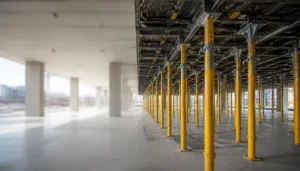
A modular early stripping shoring system changes the way a crew strips a concrete deck. Traditionally, to get your plywood sheets down, you had to drop the entire vertical scaffolding structure. This old approach forced you to leave thousands of rented props locked under a single floor for weeks.
Modern drop-head scaffolding components solve this bottleneck through a clever release design. The drop head sits directly on top of your heavy-duty vertical shoring prop. When you strike the quick-release wedge pin with a hammer, the outer collar of the head drops down by roughly 60mm to 100mm. This lowers the primary horizontal beams and plywood panels away from the concrete ceiling, while the main inner shoring post stays tightly wedged against the concrete slab.
This drop head scaffolding quick release mechanism allows you to safely remove your horizontal framing without disturbing the main vertical load-bearing path. By keeping the main shoring posts untouched, the curing slab never loses its critical center support.
To see how these vertical shores connect with high-capacity horizontal bridging components during assembly, check out our field overview on Acrow Span Rental Bangalore Solutions.
How to Reduce Formwork Cycle Times Safely
Learning how to reduce formwork cycle times safely is the fastest way to slash your equipment rental costs. When your crew utilizes a drop-head layout, you can establish a highly efficient shuttering panel rotation line.
Instead of keeping a massive inventory of scaffolding locked up on a single floor, you only need enough horizontal decking sheets to cover one or two floors. On day three, your workers strike the drop-heads, slide out the horizontal beams and plywood panels, and immediately move them up to form the next level.
This smart asset velocity dramatically cuts down your total scaffolding material rental Bangalore requirements. Your vertical shoring props stay downstairs supporting the curing concrete, while your high-cost horizontal panels work around the clock on upper decks.
Common Errors: Stripping Blended Cements Prematurely Without Cube Tests
A frequent mistake made by site supervisors is blindly applying the minimum calendar days for stripping without verifying the actual concrete mix design. The 3-day and 7-day timelines in standard charts assume you are using traditional OPC. However, modern sustainability rules mean most commercial sites now use PPC or mixes blended with heavy amounts of fly ash and ground granulated blast-furnace slag (GGBS).
Blended eco-cements significantly slow down the early hydration speed of your concrete. While an OPC mix might hit 70% of its target strength within a week, a high-volume PPC blend might only reach 45% to 50% strength in that same window. If a crew applies standard timelines to a slow-curing PPC mix without checking, the under-developed slab will suffer.
To avoid this danger, never rely solely on a wall calendar. You must cast companion concrete cubes right alongside your main floor pour. These sample cubes must cure in the exact same field conditions as your actual floor slab. Before anyone strikes a drop-head pin or removes a vertical support span, a technician must run a compression concrete cube test in the site lab to verify that the slab has physically crossed its required safety milestone.
FAQs: Managing Concrete Shuttering Cycles
Do modular drop-head systems work with traditional wooden props or local bamboo poles?
No, drop-head scaffolding components require a stable, precision-engineered metal framework to operate safely. They are designed exclusively to lock into heavy-duty modular system scaffolding or telescoping steel plumbing props. Trying to tie a quick-release head onto uneven wooden props creates dangerous structural alignment problems.
What precise percentage of concrete compressive strength is required before hitting the release pin?
Before you activate the quick-release mechanism to drop your horizontal panels at day three, the slab concrete must reach at least 50% of its target characteristic strength. For the secondary stage, when you remove the primary vertical props entirely, the mix must cross a higher compressive strength milestone of at least 70% to 85%.
How do drop-head systems affect your scaffolding material rental Bangalore expenses?
They drastically lower your overall layout costs. Because drop-heads let you reclaim your horizontal plywood panels and cross-beams in just 3 days instead of 14, you can cut the total amount of decking materials you need to rent by nearly 60%.
Action Steps: Your Pre-Stripping Site Validation Routine
To ensure structural safety during your early striking cycles, enforce this 5-step validation checklist before your crew touches a single formwork component:
- Check the Lab Cube Reports: Verify the results of your on-site concrete cube test. Ensure the samples have reached at least 50% compressive strength for a soffit drop, or 70% for total prop removal.
- Confirm Cement Curing Type: Double-check the mix delivery ticket. If the concrete contains a blended PPC mix instead of traditional OPC, automatically extend your curing time to match the slower hydration speed.
- Execute the Controlled Head Drop: Strike the drop-head quick-release mechanism cleanly with a hammer. Let the primary horizontal beams and plywood sheets drop smoothly by 60mm to 100mm, while ensuring the vertical shoring post stays tightly wedged against the ceiling.
- Inspect the Re-Propping Points: If your layout requires moving primary props, place your temporary support jacks immediately under the slab to eliminate structural sagging risks before removing the main shores.
- Clear the Panel Rotation Line: Carefully lower the freed plywood panels and hand them up to the next floor deck, keeping your high-cost horizontal assets moving at peak velocity.
Following these practical field validation steps minimizes your on-site structural risks and guarantees a flat ceiling finish. For large commercial setups or residential builds requiring premier, certified steel staging materials, working with an experienced partner like Sri Kanakadri Scaffolding ensures your project stays completely safe, code-compliant, and on schedule.
Contact Sri Kanakadri Scaffolding Today!
Phone: +91 9113276916
Visit our Google My Business Listing for Directions

About Sri Kanakadri Scaffolding Author – Sri Kanakadri provide Bangalore’s most reliable scaffolding on rental services, offering safe, cost-effective, and top-quality scaffolding rental solutions for all construction projects. With years of expertise, Sri Kanakadri Scaffolding is committed to delivering exceptional scaffolding on rental services in Bangalore that exceed client expectations. Our focus is on safety, quality, and affordability for every construction project. e specialize in scaffolding hire in Bangalore, offering reliable and cost-effective scaffolding rental solutions tailored to your needs. From construction scaffolding services to industrial scaffolding on rent, we ensure precision, safety, and efficiency in every project. Trust us for affordable scaffolding rentals that guarantee unmatched professionalism and reliability.