
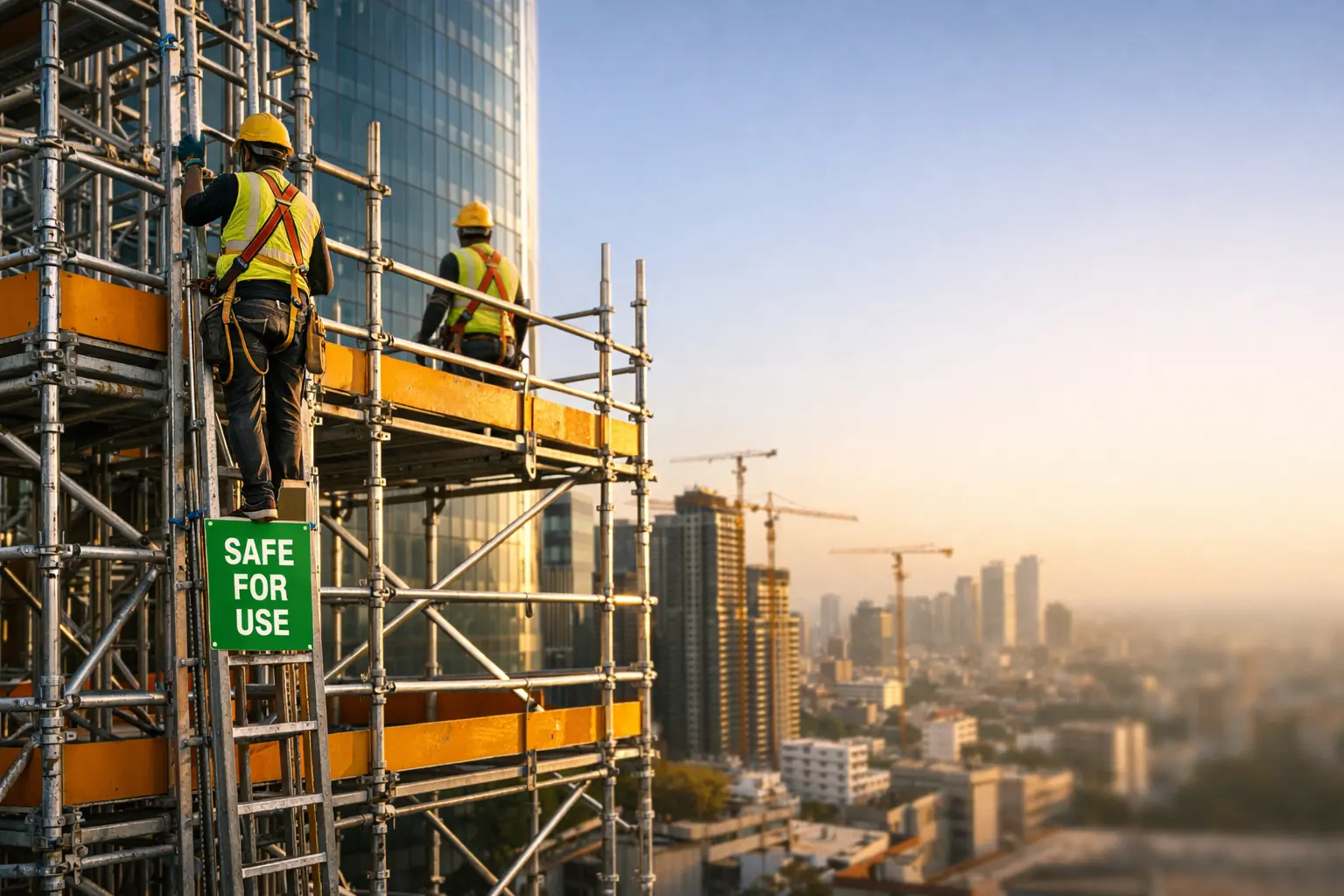
The Comprehensive Guide to Scaffolding Safety Standards, Training, and IS 2750 Compliance in India
Safety compliance in the Indian construction sector has evolved from a voluntary best practice into a critical legal mandate. As cities like Bangalore witness unprecedented urbanization, the complexity of work-at-height activities has grown exponentially. Adhering to scaffolding safety standards in India, specifically the IS 2750 code, is now the only way to ensure structural integrity and mitigate site risks. This guide provides an authoritative roadmap through regulatory compliance, safety certifications, and the expert training required to master modern construction safety in the 2026 landscape. Understanding IS 2750: The Backbone of Indian Scaffolding Standards What is IS 2750? IS 2750 is the Bureau of Indian Standards (BIS) code that specifies the requirements for steel scaffoldings. It covers material quality, dimensions of tubes, and the structural design necessary to ensure the safety of workers at height in India. The IS 2750 standard isn’t just a technical manual; it is the legal foundation for every steel scaffold erected in the country. While many international contractors in Bangalore look toward OSHA (Occupational Safety and Health Administration) for global guidance, IS 2750 is specifically calibrated to the materials and environmental stresses found in the Indian subcontinent. While OSHA focuses heavily on the “process” and management of safety, the Indian IS 2750 scaffolding specifications are deeply rooted in the structural integrity and metallurgical quality of the individual components. Key Technical Specifications of BIS 2750 To meet Indian standards for tubular scaffolding, contractors must look beyond the visual assembly and focus on material metrics. The code primarily dictates the use of Grade YST 210 or YST 240 Black Mild Steel (MS) pipes. For a structure to be deemed compliant, the standard nominal bore (NB) of the tubes must be 40mm, resulting in an outer diameter of approximately 48.3mm. A critical data point often overlooked by site supervisors is wall thickness. Under BIS 2750, the tube thickness must generally be either 3.25mm (Medium) or 4.0mm (Heavy), depending on the intended load-bearing capacity. Using “light” pipes with lower wall thickness is a common but dangerous violation; it significantly compromises the scaffold’s ability to handle vertical compression and lateral wind pressure—a major risk factor for high-rise clusters in areas like North Bangalore. Key Insight: Adhering to these specific dimensions ensures that all standard couplers and fittings lock seamlessly. Mechanical failures often occur not because a part was “broken,” but because mismatched pipe diameters prevented the fittings from achieving a secure grip. Core Safety Components: Engineering a Fail-Safe Structure Engineering a safe scaffold requires more than just high-quality steel; it requires a holistic approach to the assembly of individual components. In the industry, we often speak of a “fail-safe” structure. This means that if one component is slightly stressed, the system as a whole remains stable because the construction scaffolding safety norms were followed during the initial design and erection. Every ledger, transom, and brace must work in harmony to prevent structural collapse. The Role of Base Plates and Sole Boards in Soil Stability The safety of any scaffold begins at the ground level. A common oversight on Bangalore sites is ignoring ground conditions, especially during the monsoon season when the earth becomes soft and unpredictable. Scaffolding base plate safety is critical because the base plate is responsible for transferring the entire weight of the structure and its occupants into the earth. However, on soft or uneven terrain, a steel base plate alone is insufficient. In such cases, we use sole boards—wide timber or steel planks placed under the base plates—to further distribute the load across a larger surface area. Without proper load distribution, the vertical “standards” can sink into the ground, causing a disastrous tilt. In areas like Sarjapur or Hebbal, where construction often happens on reclaimed land, using a combination of adjustable base jacks and heavy-duty sole boards is not just a recommendation; it is a necessity for structural survival. Guardrails and Toe Boards: Preventing Fall Hazards Falls from height remain the leading cause of construction fatalities. To achieve effective scaffolding fall protection, the installation of guardrails and toe boards is non-negotiable. According to IS code safety benchmarks, a standard guardrail system must include: Main Guardrail: Fixed at a height of 950mm to 1200mm above the working platform. Mid-rail: Positioned so that the gap between the toe board and the main rail does not exceed 470mm. Toe Boards: Must be at least 150mm high to prevent tools or materials from accidentally being kicked off the edge onto people below. Key Insight: Never use scrap wood or thin wires as substitutes for proper guardrails. A compliant system must be rigid enough to withstand the weight of a worker leaning or falling against it without bending or dislodging from the standards. The Human Element: Training and the “Competent Person” Role Even the most technologically advanced scaffold, built with the highest-grade IS 2750 steel, is only as safe as the people who assemble and use it. In the construction industry, we emphasize that safety is a shared responsibility, but the legal and structural burden rests on the shoulders of the “Competent Person.” Under scaffolding safety training in India, a competent person is defined as someone capable of identifying existing and predictable hazards and who has the specific authorization to take prompt corrective measures to eliminate them. Expert Tip: In 2026, Bangalore municipal authorities and major developers often require Third-Party Inspection (TPI) for projects exceeding 15 meters. Never rely solely on an internal audit for high-rise steel structures; ensuring your supervisor is a certified “Competent Person” is your first line of defense against legal liability. Mandatory Training Modules for Site Workers Proper scaffolding safety certification isn’t a one-time event but a continuous process of education. For workers in Bangalore’s fast-paced hubs like Manyata Tech Park or Electronic City, training must be practical and language-accessible. Essential training modules should include: Assembly & Dismantling Sequence: Understanding the step-by-step logic to ensure the structure never becomes unstable during the “build” or “teardown” phases. Load Recognition: Teaching workers to identify the difference between light-duty and heavy-duty